Offer Letter Template: Free, Editable Job Offer Letter
Copy a free offer letter template for full-time, hourly, or email offers, plus a contingency clause, a filled-in sample, and what to leave out.
This guide is general information, not legal advice. Employment rules vary by location; check the official source for yours.
An offer letter is the written version of a job offer: it turns a verbal yes into terms the candidate can review and sign. If you’ve just picked someone, copy the template below, fill it in from the job details you agreed, and send it with a deadline to respond.
Quick answer
- Include: job title, manager, start date, pay and pay frequency, full-time or part-time, exempt or hourly status, benefits eligibility, conditions, and a response deadline.
- State that the job is at-will and that the letter isn’t a contract for a fixed term. That’s the US norm, though Montana has its own rules.
- Leave out: promises of job security, noncompete terms in states that ban them, and anything your payroll or benefits setup can’t back up.
Offer letter template
This offer letter template fits most full-time salaried hires at a small US company. Keep it to one or two pages.
[Company letterhead]
[Date]
[Candidate full name]
[Candidate email or address]
Re: Offer of employment
Dear [Candidate first name],
We’re pleased to offer you the position of [Job title] at [Company legal name]. You’ll report to [Manager name and title] and work [on site at (location) / remotely from (state) / on a hybrid schedule at (location)].
Start date: [Start date]
Pay: You’ll be paid at an annual rate of $[Amount], which is $[Amount per pay period] per pay period, paid [weekly/biweekly/semimonthly/monthly], less applicable taxes and withholdings.
Status: This is a [full-time/part-time], [exempt/nonexempt] position. [Your regular schedule is (days and hours).]
Benefits: You’ll be eligible for [health insurance, retirement plan, PTO, or other benefits] under the terms of each plan, which may change. [Eligibility begins (date or waiting period).] Details are in the attached benefits summary.
Other compensation (optional, delete if none): [Signing bonus, commission plan, or equity], subject to the terms of [plan document or agreement].
Conditions: This offer depends on [a background check / reference checks / your signing our confidentiality agreement], and on proof of your identity and authorization to work in the United States, as required for all new hires.
Your employment with [Company legal name] is at-will. This means either you or the company may end it at any time, with or without cause or notice. This letter isn’t a contract for any fixed period of employment, and only [title of authorized officer] can change that in a signed written agreement.
To accept, please sign below and return this letter by [Response deadline]. If you have questions, contact [Name or role] at [Email or phone].
We’re looking forward to working with you.
Sincerely,
[Signature]
[Signer name]
[Signer title]
[Company legal name]
Acceptance
I accept this offer of employment on the terms above.
Signature: ______________________
Name: [Candidate full name]
Date: ______________________
More versions for common situations
Every offer letter version keeps the same structure. What changes is how much detail the offer needs and how pay is described.
Short email offer
Use this when the full letter is attached for signature, or as a quick written follow-up to a verbal offer.
Subject: Offer of employment: [Job title] at [Company name]
Hi [Candidate first name],
Thanks for your time throughout the process. I’m happy to confirm our offer for the [Job title] role, reporting to [Manager name].
- Start date: [Start date]
- Pay: $[Amount] per [year/hour], paid [pay frequency]
- Status: [Full-time/Part-time], [exempt/nonexempt]
- Conditions: [Background check / references], plus proof of work authorization on your first day
The attached offer letter has the full details. Please sign and return it by [Response deadline], or reply with any questions.
Best,
[Your name]
[Your title], [Company name]
Hourly or part-time offer
For nonexempt roles, pay is an hourly rate, overtime eligibility is stated, and hours are an estimate, not a promise. Replace the pay and status lines in the main template with these.
Pay: You’ll be paid $[Hourly rate] per hour, paid [weekly/biweekly], less applicable taxes and withholdings. This is a nonexempt position, so you’ll be paid overtime for hours worked over 40 in a workweek [and any other overtime required by (state) law].
Schedule: We expect you to work about [Number] hours per week, usually [days and shift times]. Hours may change based on business needs, and this estimate isn’t a guarantee of a minimum number of hours.
Status: This is a [part-time/full-time], nonexempt, at-will position.
Contingency clause
A contingency clause makes the offer depend on a condition, such as a background check or reference checks. If the offer depends on a check, say so plainly and say what happens if the condition isn’t met. This wording works with the background check steps covered below.
This offer is contingent on the satisfactory completion of [a background check / a driving record check / reference checks]. We’ll ask for your written authorization before any background check is run, and you’ll receive any notices required by law before a final decision. If a contingency isn’t met, [Company legal name] may withdraw this offer.
How to fill in each part
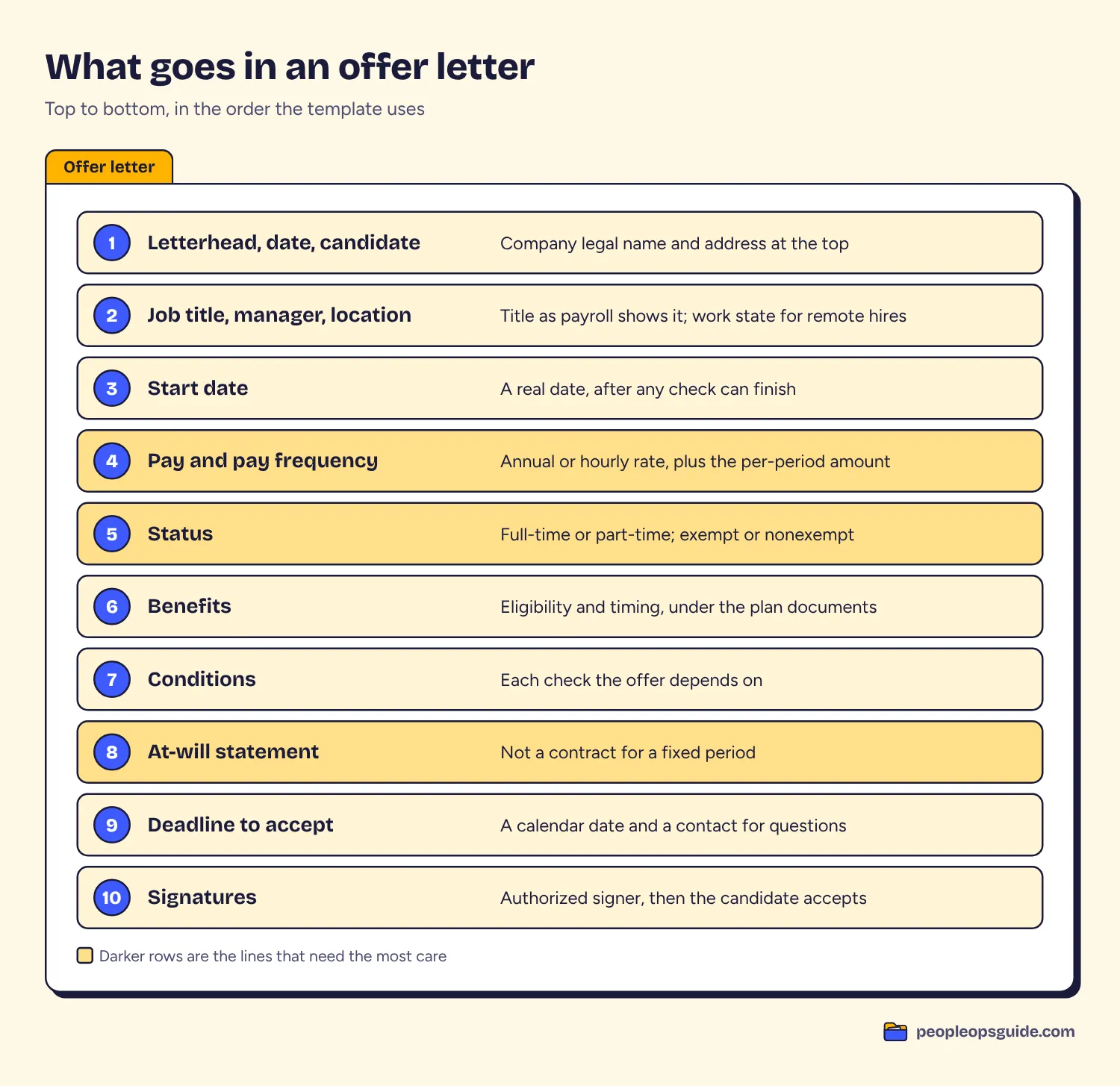
| Field | What to write | Watch out for |
|---|---|---|
| Job title and manager | The title as it will appear in payroll, and who they report to | Don’t inflate the title to close a candidate |
| Work location | Office address, or the state they’ll work from if remote | The work state decides which pay, leave, and tax rules apply |
| Start date | A specific date | Leave time for any background check to finish |
| Pay | Annual salary or hourly rate, plus pay frequency | Give the per-period amount too, so the annual figure isn’t read as a guarantee |
| Status | Full-time or part-time, exempt or nonexempt | Exempt status depends on duties and salary, not the title |
| Benefits | What they’re eligible for and when | Say benefits follow the plan documents, which may change |
| Conditions | Each check the offer depends on | Run criminal history checks only when your local rules allow it |
| At-will statement | The standard paragraph from the template | Delete “permanent” or “job security” wording anywhere else |
| Deadline | A calendar date to respond | “ASAP” invites confusion |
| Signature and acceptance | An owner or officer signs; the candidate countersigns | Only someone authorized to hire should sign |
Send it as a PDF or through an e-signature tool, and keep the signed copy in the new hire’s personnel file.
Filled-in sample
This sample offer letter is the full-time template with the details filled in. The candidate and the company are made up.
Sample offer letter
Northfield Design Studio LLC
48 Mill Street, Burlington, VT 05401
November 9, 2026
Taylor Sample
taylor.sample@example.com
Re: Offer of employment
Dear Taylor,
We’re pleased to offer you the position of Project Manager at Northfield Design Studio LLC. You’ll report to our Operations Director and work on a hybrid schedule at our Burlington office.
Start date: December 7, 2026
Pay: You’ll be paid at an annual rate of $68,000, which is $2,615.38 per pay period, paid biweekly, less applicable taxes and withholdings.
Status: This is a full-time, exempt position.
Benefits: You’ll be eligible for health insurance and our 401(k) plan under the terms of each plan, which may change, starting the first of the month after your start date. You’ll also accrue PTO under our PTO policy.
Conditions: This offer depends on a background check and on proof of your identity and authorization to work in the United States, as required for all new hires.
Your employment is at-will. Either you or the company may end it at any time, with or without cause or notice. This letter isn’t a contract for any fixed period of employment.
To accept, please sign below and return this letter by November 13, 2026. Questions? Contact our Operations Director at hiring@example.com.
Sincerely,
[Signature]
Founder
Northfield Design Studio LLC
What should you leave out of an offer letter?
A good offer letter is short. Leave out these six things, which cause more trouble than they’re worth:
- Job security language: “permanent position,” “long-term role,” or “we expect you to be here for years.” Words like these can undercut the at-will statement.
- Pay as a yearly promise: “you will earn $68,000 this year.” Give the annual rate and the per-period amount instead.
- Detailed benefit promises: exact premiums or match percentages that may change. Point to the plan documents.
- Bonus guarantees you don’t mean: if a bonus is discretionary, say so, or leave it out.
- Noncompete terms in a state that bans them, and broad restrictions for roles that don’t need them. Use a separate confidentiality agreement for trade secrets.
- Questions about salary history or protected traits: the offer stage is still part of hiring, and anti-discrimination rules still apply.
Which laws shape an offer letter?
Five sets of rules shape a US offer letter: at-will employment, exempt status under the FLSA, background check law, noncompete limits, and new hire paperwork. None of them change the template much, but each one decides a line or two in it. US rules come first, then a note for the UK.
At-will employment (US)
At-will employment means either the employer or the employee can end the job at any time, with or without cause or notice. Most US employment is at-will, which is why the template says so. Montana is the main exception: after the employer’s probationary period, a discharge without good cause can be wrongful under the state’s Wrongful Discharge from Employment Act. If you hire in Montana, state the probationary period in the letter and have the at-will paragraph checked.
Exempt or hourly
Under the federal Fair Labor Standards Act (FLSA), exempt employees aren’t owed overtime, but only if their duties qualify and they’re paid enough on a salary basis. As of November 2026, the federal standard salary level is $684 per week, or $35,568 a year, and some states set a higher bar. If the role doesn’t clearly qualify, treat it as nonexempt and use the hourly lines. Our overtime calculator shows what a nonexempt employee would earn for a given week.
Background checks
If a background check company prepares the report, the federal Fair Credit Reporting Act (FCRA) applies. You must give the candidate a written disclosure in a stand-alone document, not buried in the offer letter or application, and get their written permission. If the report leads you to withdraw the offer, you must first send a pre-adverse action notice with a copy of the report and a summary of their rights, then a final notice.
State and local rules can add steps. Under California’s Fair Chance Act, employers generally may not ask about criminal history before a conditional job offer. To withdraw an offer over a conviction, they must make an individualized assessment, notify the candidate in writing, let them respond, and send a written final decision. Several other states and cities have similar fair chance rules.
Noncompetes
The FTC’s nationwide noncompete ban never took effect. A federal court set it aside in 2024, and the FTC dropped its appeal in September 2025, though it still pursues individual cases. That leaves state law in charge. California, for example, makes it unlawful to include a noncompete clause in an employment contract unless an exception applies. Keep noncompetes out of the offer letter, and get legal advice before using one anywhere.
New hire paperwork
- Form I-9: the new hire completes Section 1 no later than their first day, and can do it any time after accepting. You complete Section 2 within three business days of the hire. Mention work authorization in the letter as a condition for everyone, never only for some candidates.
- State pay notices: some states require a separate written notice at hire. In California, nonexempt employees must get a Labor Code 2810.5 notice with pay rates, payday, employer details, and the workers’ compensation carrier, no later than the first day of work. The offer letter doesn’t replace it.
United Kingdom
UK employers must give a written statement of employment particulars on the first day of employment, covering items such as pay, hours, holiday entitlement, place of work, and any probation period. A UK offer letter usually says the offer is subject to conditions such as references and the right to work, and doesn’t use US at-will wording.
Check local rules
Pay notice, background check, noncompete, and final pay rules vary by state, city, and country. Before you hire in a new location, check that state’s labor department site. If you plan to use a noncompete or a fixed-term contract, or you need to withdraw an accepted offer, talk to an employment lawyer.
How do you make and send a job offer?
A job offer goes out in six steps, from the phone call to first-day paperwork.
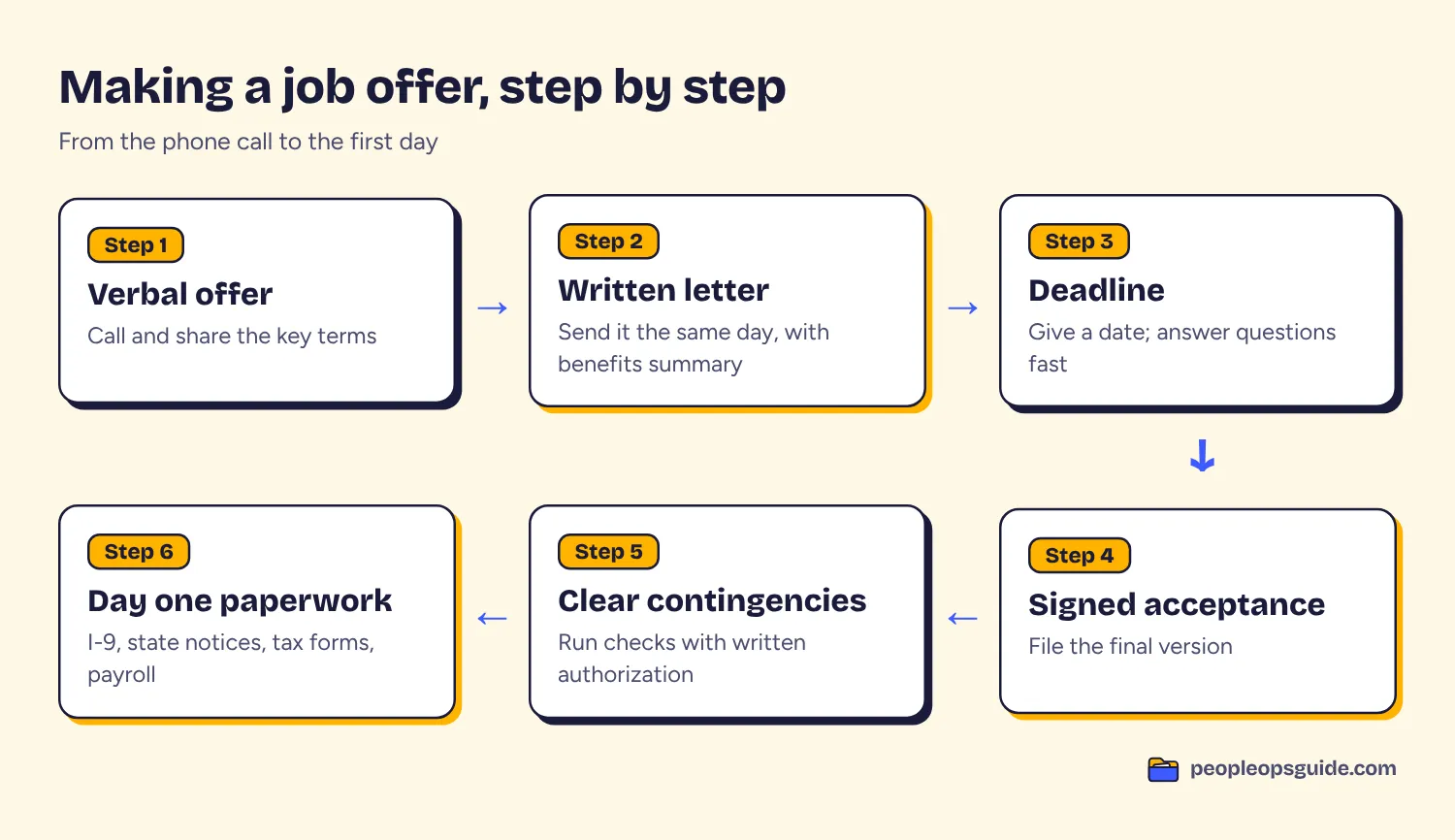
- Make the verbal offer. Call the candidate, share the key terms, and tell them the written offer is coming.
- Send the written letter the same day. Use the template and attach the benefits summary. Many applicant tracking systems can send offers for e-signature, which helps if you hire often. Our ATS comparison covers the options.
- Set a deadline and stay available. Answer questions quickly. If you change any term, send a revised letter rather than agreeing by text.
- Get the signed acceptance. Countersign if needed, and store the final version in the personnel file. It’s the record you’ll check later if, say, a lender asks you for an employment verification letter.
- Clear the contingencies. Run the background or reference checks you listed, with the required authorization.
- Prepare day one. Line up the I-9, any state notices, tax forms, and payroll setup before the start date.
Mistakes that cause problems
- Terms that don’t match payroll. The letter says $68,000 but payroll is set up at $65,000. Have whoever runs payroll check the pay line before you send it.
- Different terms in emails. A manager promises a remote day or a review in six months that never made the letter. Keep all terms in the signed version.
- Calling a role exempt because it’s salaried. Salary alone doesn’t make someone exempt.
- A background check before the offer in a place with fair chance rules.
- No deadline. Without one, you can’t tell when to move to your second choice.
Final notes
What most small teams should do
Save the full-time template and the hourly lines with your other HR letters and templates, and use the same letter for every hire in a role. Keep it short, state at-will status, match pay wording to the role’s exemption status, list each contingency, and send it with a firm deadline.
Get new HR templates and tools by email
New templates, plain-English guides, free tools, and HR rule changes worth knowing. About twice a month; unsubscribe any time.
Used only to send the newsletter. Privacy policy
You’re on the list. The first email is on its way soon.
Frequently asked questions
What is an offer letter?
It's the written version of a job offer. It sets out the main terms, such as job title, start date, pay, schedule, and any conditions, and asks the candidate to accept by signing. In the US, most offer letters say the job is at-will so the letter isn't read as a contract for a fixed term.
Is an offer letter legally binding?
It depends on what it says and where you are. A short letter that states at-will employment and avoids promises is usually treated as a summary of terms, not a guarantee of a job for a set period. Wording like "permanent position" or a guaranteed annual salary can change that. If you're unsure about a specific letter, ask an employment lawyer.
What's the difference between an offer letter and an employment contract?
An offer letter is short and covers the basics. An employment contract is longer and usually adds a fixed term, notice periods, termination terms, and restrictive covenants. Most small US companies use an offer letter for most hires and keep contracts for senior or fixed-term roles. In the UK, you also owe a written statement of particulars on day one, whatever you call your offer document.
How long should a candidate have to accept?
There's no general legal rule. Three to five business days is common practice. Give a real date in the letter rather than "as soon as possible", and say who to contact with questions. If the candidate needs longer, agree a new date in writing.
Can you withdraw a job offer after it's accepted?
Sometimes, but it's risky, especially if the candidate has already resigned from their old job. If the reason is a background check result, follow the federal FCRA steps and any state or local fair chance rules, such as California's notice and response steps. Talk to an employment lawyer before withdrawing an accepted offer for any other reason.
Should the letter show an annual salary or an hourly rate?
Match how you'll actually pay. For a salaried exempt role, give the annual salary and the pay frequency. For an hourly role, give the hourly rate, say the role is eligible for overtime, and give expected weekly hours as an estimate. Stating pay per pay period, not per year, also avoids any reading that you've promised a full year's salary.
Found this useful? Get the next one by email
New templates, plain-English guides, free tools, and HR rule changes worth knowing. About twice a month; unsubscribe any time.
Used only to send the newsletter. Privacy policy
You’re on the list. The first email is on its way soon.
More in Letters and templates
Employment Verification Letter: Free Template and Sample
Copy a free employment verification letter template for current or former employees, plus an authorization form, a filled-in sample, and what to leave out.
Paystub Template: Free Pay Stub Layout for Employers
Copy a free paystub template for hourly or salaried employees, with a filled-in 2026 sample, the fields California and New York require, and mistakes to avoid.
Termination Letter Template: Free Samples for Employers
Copy a free termination letter template for performance, conduct, or layoff exits, plus a filled-in sample and the state notices to send with it.