Employment Verification Letter: Free Template and Sample
Copy a free employment verification letter template for current or former employees, plus an authorization form, a filled-in sample, and what to leave out.
This guide is general information, not legal advice. Employment rules vary by location; check the official source for yours.
An employment verification letter confirms facts about someone’s job for a lender, landlord, new employer, or agency. If a request just landed on your desk, copy the template below, swap in details from your records, and you’re most of the way done.
Employment verification letter template
This facts-only version fits most requests, including landlords and new employers.
[Company letterhead]
[Date]
[Recipient name or organization, or “To whom it may concern”]
[Recipient address or email]
Re: Employment verification for [Employee full name]
To whom it may concern:
This letter confirms that [Employee full name] has been employed by [Company legal name] since [Start date]. [He/She/They] currently [holds/hold] the position of [Job title] in [Department] and [works/work] [full-time/part-time].
This letter confirms the information shown in our records as of the date above. It is not a promise of continued employment.
If you need to confirm this letter, please contact [HR contact name or role] at [Company main phone number] or [Company email address].
Sincerely,
[Signature]
[Signer name]
[Signer title]
[Company legal name]
More versions for common requests
The core letter stays the same. Only a few lines change depending on who’s asking and whether the person still works for you.
With pay details
Use this for a lender, landlord, or benefits application once the employee has authorized it in writing.
[Company letterhead]
[Date]
[Recipient name or organization]
Re: Employment and income verification for [Employee full name]
To whom it may concern:
At the written request of [Employee full name], this letter confirms the following from our records as of the date above:
- Position: [Job title]
- Employment dates: [Start date] to present
- Status: [Full-time/Part-time], [Regular/Temporary]
- Pay: $[Amount] gross per [hour/year], paid [weekly/biweekly/semimonthly/monthly]
- Regular hours: [Hours] per week
- Year-to-date gross earnings: $[Amount] as of [Pay date] (optional)
This letter is not a promise of continued employment or of any future pay.
To confirm this letter, please contact [HR contact name or role] at [Company main phone number].
Sincerely,
[Signature]
[Signer name and title]
[Company legal name]
Former employee
Use this version once someone has left. Reason for leaving and rehire eligibility stay out unless a law or a signed authorization requires them.
[Company letterhead]
[Date]
[Recipient name or organization, or “To whom it may concern”]
Re: Employment verification for [Employee full name]
To whom it may concern:
This letter confirms that [Employee full name] was employed by [Company legal name] from [Start date] to [End date]. [His/Her/Their] most recent position was [Job title].
This information reflects our records as of the date above. To confirm this letter, please contact [HR contact name or role] at [Company main phone number].
Sincerely,
[Signature]
[Signer name and title]
[Company legal name]
Employee authorization form
This is the piece that’s easy to skip, but it makes sharing pay or a detailed record much easier to defend later. Keep the signed copy with your response.
I authorize [Company legal name] to release the information checked below about my employment to:
Recipient: [Name of lender, landlord, employer, or agency]
Purpose: [For example, mortgage application or apartment lease]
Information to release:
☐ Job title
☐ Employment dates
☐ Full-time or part-time status
☐ Pay rate and frequency
☐ Year-to-date or annual gross earnings
☐ Other: [Describe]
This authorization ends on [Date, for example 90 days from today]. I can withdraw it earlier by telling [HR contact name or role] in writing, except for information already released.
Employee name: [Print name]
Signature: [Signature]
Date: [Date]
How to fill in each part
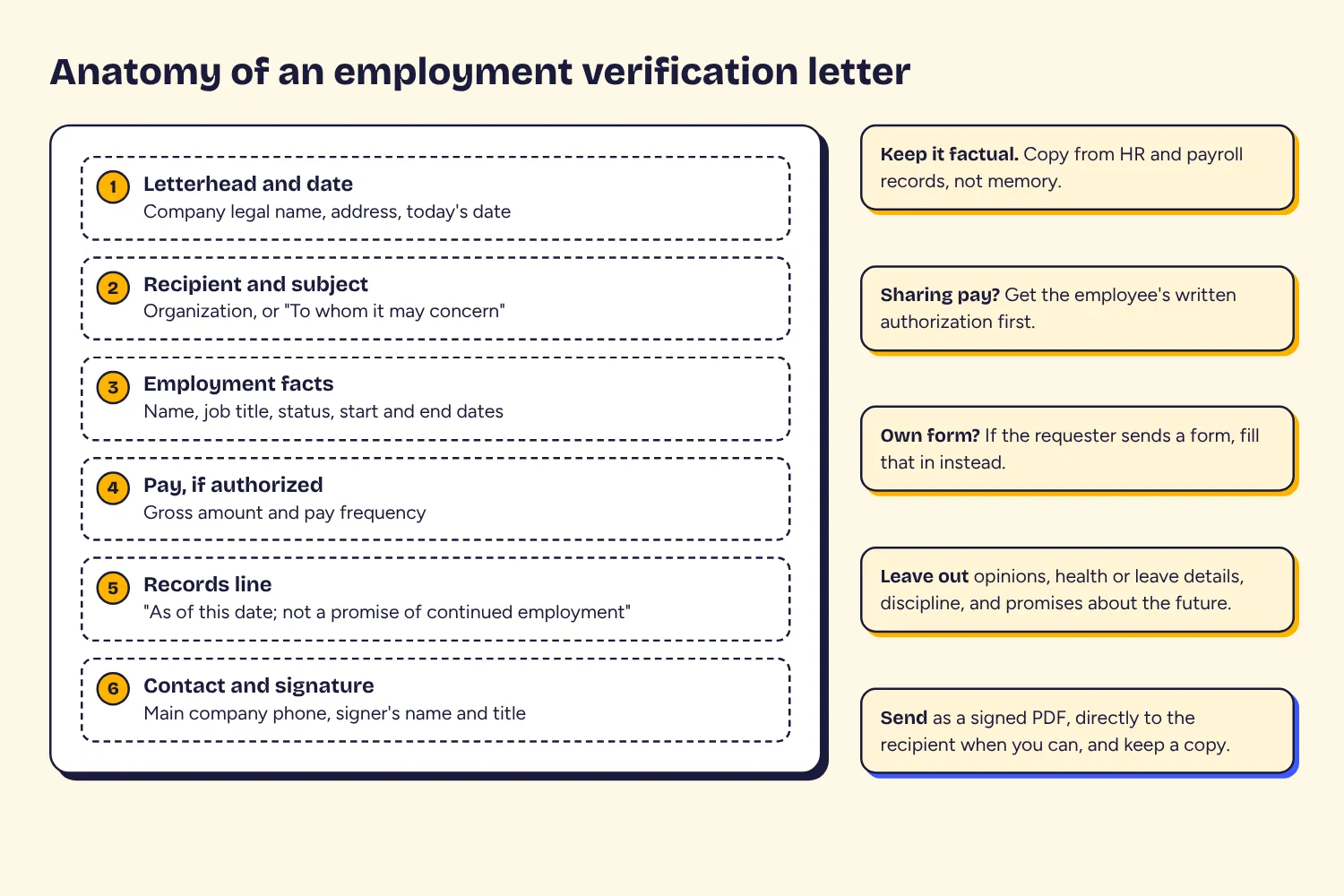
| Field | What to write | Watch out for |
|---|---|---|
| Letterhead | Your standard company letterhead, or legal name and address at the top | A plain email with no company details is easier to question |
| Date | The day you sign it | Lenders and agencies may reject old letters, so don’t reuse one |
| Recipient | The organization’s name, if known | Use “To whom it may concern” only when it’s going to several parties |
| Job facts | Title, department, status, and dates, copied from HR or payroll records | Don’t write from memory |
| Pay | Gross amount and pay frequency, only if authorized | Label it gross, and don’t estimate raises or bonuses |
| Contact | A role and your main company number | Give a company number the recipient can look up |
| Signature | Someone who can see the records and answer questions | Make sure they can back up every line |
Send it as a PDF with the signature in place. If you’re mailing or handing over a paper copy, keep a scan of what you sent.
Filled-in sample
Here’s how the facts-only letter looks once it’s filled in. The employee and the company are made up.
What to leave out
A verification letter has one job: confirming facts. These don’t belong in it, even if a recipient asks:
- Opinions: “great employee,” “reliable,” or performance ratings. Save those for a reference, and only if your reference policy allows it.
- Health, leave, or family details: including why someone was out, or anything about pregnancy or disability.
- Discipline or reason for leaving: unless a law or a signed authorization requires it.
- Promises: future pay, future raises, or “will remain employed.” Add the line that the letter isn’t a guarantee of continued employment.
- Sensitive identifiers: Social Security numbers and bank details, unless a required form specifically needs them and the employee has authorized it.
- Anything you can’t support: if your records don’t show it, don’t state it.
How to handle a request
A small team doesn’t need a complicated system, just the same five steps every time, ideally with one named owner.
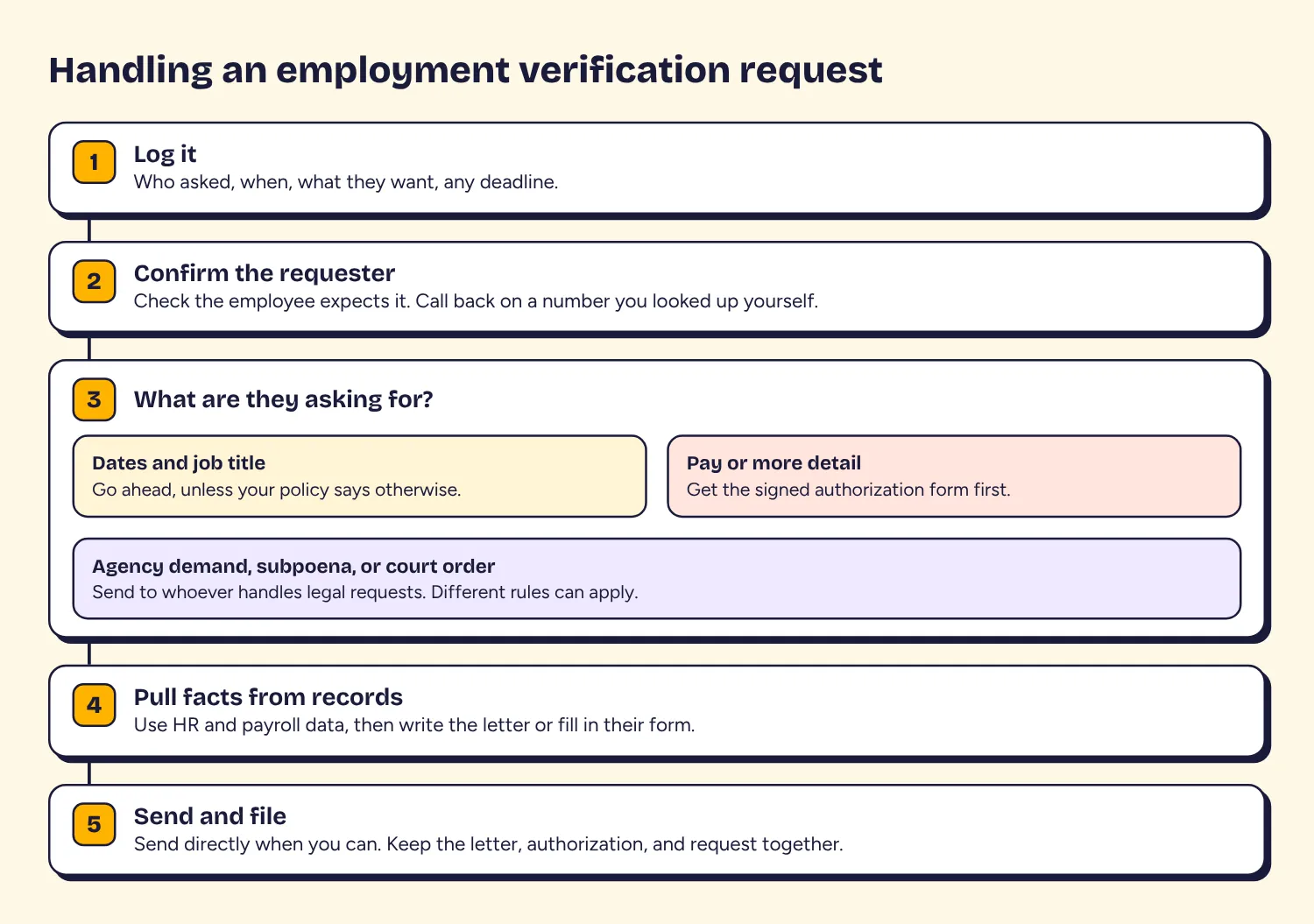
- Log the request. Note who asked, when, what they want, and any deadline.
- Confirm the requester. Check that the employee actually expects this request. For a phone or email request, look up the organization’s main number yourself and call back. Don’t rely on contact details included in the request.
- Check what’s being asked. Dates and title are low-risk. For pay or anything more detailed, get the authorization form signed first. If it’s a government agency, route it to whoever handles those requests, since different rules can apply.
- Pull facts from records. Use HR and payroll data rather than memory.
- Send and file. Send it directly to the recipient when possible, and store a copy with the authorization and the request.
Some companies hand this off to an automated verification service. The U.S. Department of Labor, for example, uses The Work Number for third-party checks on its employees. Most small teams don’t get enough requests to need one, but it’s worth a look if you’re fielding them every week.
Who’s asking, and what they usually need
The requester should shape what you send. Often they have their own form, and in that case you fill in the form rather than write a letter.
| Requester | What they usually want | What to do |
|---|---|---|
| Mortgage lender | Dates, position, pay, sometimes a completed Fannie Mae Form 1005 | Use their form if provided. The borrower signs Form 1005 when authorizing direct verification from you, or the lender can use a blanket authorization. |
| Landlord | Proof of employment and often pay | Facts-only letter, or the pay version with authorization. |
| New employer | Dates and title | Facts-only letter. Pay stays out unless the employee asks you to share it, since California, for example, bars employers from seeking an applicant’s salary history, and some other places have similar rules. |
| Subsidized housing provider | Verification form covering pay and hours | For HUD multifamily programs, an employer form is one accepted source, and owners are told to check pay frequency, expected raises, and overtime. Answer only from your records. |
| Child support agency | Employment status, pay, income, and possibly health coverage | Treat this as a legal request. Employers must share this information with state agencies and some states may require a direct reply rather than one from a vendor. |
| Visa office or immigration lawyer | Job title, dates, pay, sometimes job duties | Use the pay version if authorized, and ask what format they need. |
Do you have to respond?
For most private requests, you generally don’t have to. One employer verification provider says no law requires an answer to non-government requests, while government requests often do need one. Many employers respond anyway, because their employees often need the letter to rent or buy a home.
A few rules are worth knowing:
- Child support (US): federal law requires states to make all employers promptly provide employment, pay, and benefit information to child support agencies, and to sanction failures to respond.
- Missouri: corporations with seven or more employees must, on a proper written request from an employee with at least 90 days of service, issue a service letter within 45 days. It covers the nature and length of the work and the true reason for leaving, so it’s a different document from the template above.
- Fair Credit Reporting Act (US): information limited to your own dealings with the employee is excluded from the definition of a consumer report. One more reason to stick to your own records. Consumer reporting agencies have their own duties, and a 1998 FTC staff opinion warns that opinions and unsolicited information can change how a report is treated.
- Form I-9 (US): this is a separate process. You complete a Form I-9 for each new hire to verify employment authorization, and it doesn’t replace a verification letter.
- United Kingdom: an employer generally doesn’t have to give a reference, with exceptions such as a written commitment or certain financial services roles. Any reference given must be accurate and fair.
Mistakes that cause problems
- Replying to a fake request. Anyone can claim to be a lender in an email. Calling back on a number you looked up yourself takes two minutes.
- Different answers from different people. A manager’s phone reply can contradict the letter. Send all requests to one person or inbox.
- Overstating pay. Including expected bonuses as if they were salary can mislead a lender. Report what’s in payroll.
- Writing a letter for someone who hasn’t asked. Check with the employee first, unless it’s a legal demand.
Final notes
Frequently asked questions
What is an employment verification letter?
It's a short letter from an employer that confirms facts about someone's job, usually their dates of employment and job title, and sometimes their pay. Lenders, landlords, and new employers are the usual requesters. It's also called a proof of employment letter or a VOE letter. It is not the same as Form I-9, which you complete for each new hire.
Who should write it, and how quickly?
Whoever has access to the records, usually HR, payroll, or the owner at a small company. A direct manager shouldn't write one from memory. A two or three business day target is reasonable, since a mortgage or lease can be waiting on it. Check for any state or agency deadline that applies.
Is "To whom it may concern" okay?
Yes, it's a common greeting when the employee needs a letter to hand to several parties, such as a landlord or a visa office. If you know who's asking, use the organization's name instead, and send the letter directly to them when you can.
Do I need the employee's permission?
As a matter of good practice, yes, and always in writing before you share pay. Many employers confirm only dates and job title without it. A lender's Form 1005 usually comes with the borrower's signature. If a government agency demands the information, ask your lawyer or the agency what authority applies, because consent may not be the deciding factor.
Can the letter include salary?
Yes, when the employee has authorized it or a required form calls for it. State the pay rate and how often it's paid, and whether the figure is gross. Don't estimate future raises, bonuses, or overtime unless your records support them and the form asks for them.
What if a former employee asks years after leaving?
Use the former employee version and confirm only what your records show. If the records are incomplete, say what you can confirm instead of guessing. Keep your copy with their file, in line with your record retention schedule.